
Your Cart is Empty
Get 10% off all orders over £50. Discount applied automatically at checkout.
Get 10% off all orders over £50. Discount applied automatically at checkout.

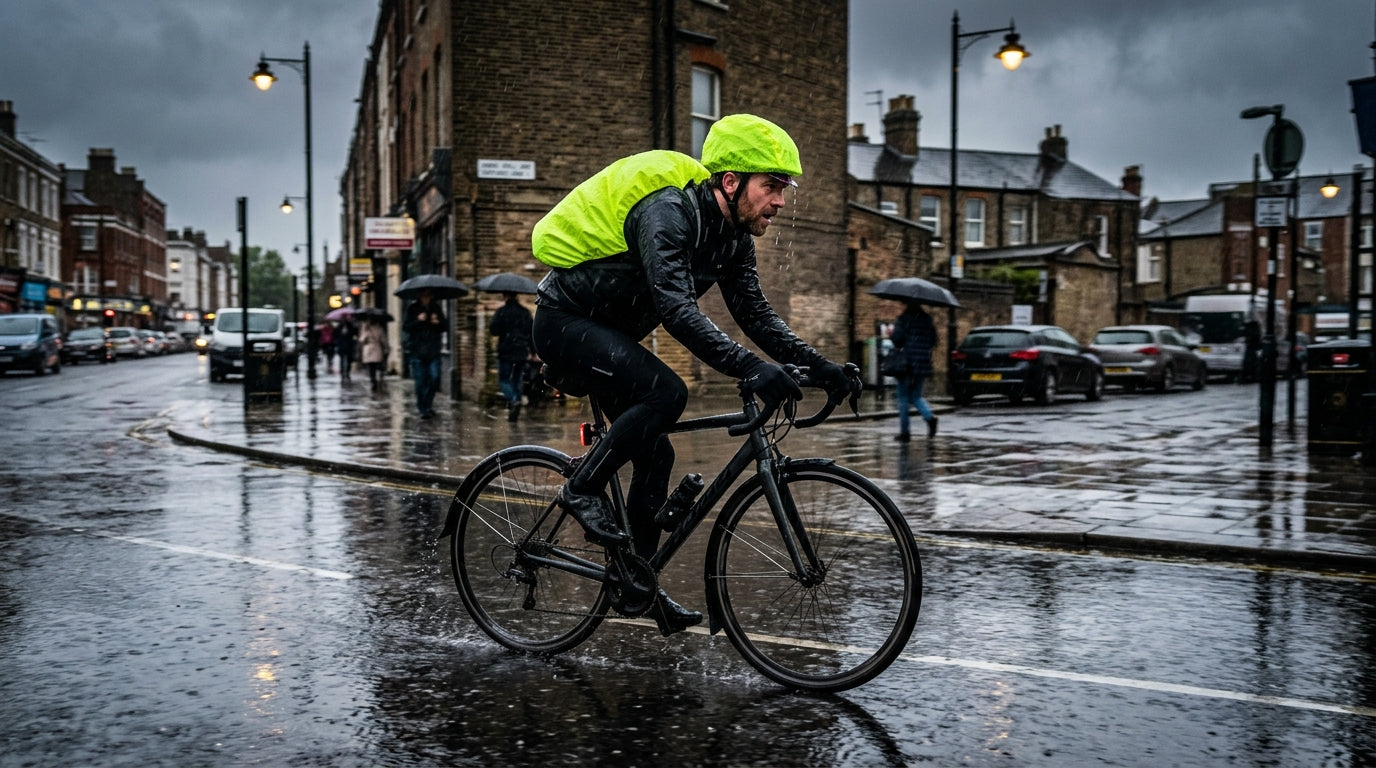
You've seen them on commuters' heads at traffic lights on drizzly mornings. Bright yellow, slightly odd-looking, stretched over a cycling helmet like a shower cap for the road. But do cycling helmet covers actually work? Or are they just another piece of kit that sits in a drawer after one use?
Having ridden through more British downpours than we'd care to count, we can give you a straight answer. Yes, they work. But they're not magic, and they're not for everyone. Here's an honest breakdown of what a bike helmet cover can and can't do, and when it's worth adding one to your cycling kit.
A cycling helmet cover is a lightweight shell that fits over your existing helmet. Most are made from nylon or polyester with a waterproof coating and taped seams. The better ones add hi-vis colours or reflective panels for visibility in low light.
They serve three purposes: keeping rain out of your helmet vents, blocking wind chill on cold rides, and making you more visible to drivers. Some riders buy them purely for the waterproofing. Others want the visibility boost. Most end up appreciating both, plus the warmth they didn't expect.
The UK gets roughly 159 days of rain or snow per year. If you cycle to work, that's about every other commute where rain is a possibility. And modern cycling helmets are designed with large vents to keep you cool in summer, which means they're essentially funnels for rainwater in bad weather.
A waterproof helmet cover seals those vents. Rain hits the cover and runs off instead of dripping onto your head and down your neck. It's a simple concept, and it genuinely works. In light to moderate rain, your head stays completely dry. In a proper downpour, you'll still be noticeably drier than riding without one.
The difference is most obvious on longer rides. A 10-minute dash to the shops? You'll survive bareheaded. But a 45-minute commute through steady rain is a different story. Cold water running down your forehead and into your eyes isn't just annoying. It's distracting, and it makes the whole ride miserable. A bike helmet cover eliminates that problem entirely.
One thing to note: a helmet cover protects the top of your head, not your face. If you want full rain protection, you'll still want a peaked cap underneath or a jacket with a decent collar. But for the specific problem of rain pouring through helmet vents, a cover is the most effective solution available.
Not all bicycle helmet covers are equally waterproof, though. Cheaper ones use a basic water-resistant coating that works for drizzle but soaks through in heavier rain. A proper waterproof bike helmet cover will have taped seams and a durable water-repellent finish that holds up through a full commute in steady rain. If you're buying one specifically for wet weather, check that it's genuinely waterproof rather than just splash-proof.
This is the surprise benefit that converts most sceptics. Helmet vents don't just let rain in. They channel cold air directly onto your head at speed.
Riding at 15mph in 5°C air creates a wind chill effect closer to -1°C on exposed skin. Your head, with all those helmet vents wide open, takes the worst of it. A cycling helmet cover blocks that airflow completely, and the difference is dramatic. Most riders who try one for the first time say it feels like their head is suddenly wearing a warm hat, without any of the bulk.
The sweet spot for wind chill protection sits between about 3°C and 10°C. Below 3°C, you'll probably want a thermal skull cap underneath as well. Above 10°C, the cover can make your head too warm, especially on climbs or during harder efforts. Experienced commuters keep a helmet cover in their jersey pocket from October to March and pull it on when the temperature drops.
Around 40% of cyclist fatalities in the UK happen during darkness. Department for Transport figures show that night riding is between two and five times more dangerous than daytime cycling. Anything that makes you more conspicuous to drivers is worth considering.
A hi-vis helmet cover puts a large block of fluorescent colour at the highest point on your body, right where drivers' headlights catch first. Reflective versions bounce light back to drivers from a distance, working in the same way as reflective jackets and backpack covers. The key advantage of a helmet cover is its position. It sits above everything else, making it visible even when your body is obscured by car doors or street furniture.
A bright yellow or reflective cycling helmet cover won't replace proper front and rear lights. But it adds a layer of visibility that's especially useful at junctions, where most urban cycling accidents happen. Our waterproof hi-vis helmet cover combines fluorescent yellow with reflective strips, so it works in daylight and after dark. A reflective helmet cover is particularly effective because headlights hit it at the perfect angle, bouncing light straight back to approaching drivers.
No product is perfect, and pretending otherwise doesn't help anyone. Here's what you should know before buying a cycling helmet cover.
By sealing the vents, you're trapping some moisture from sweat inside the helmet. On a hard ride in mild weather (above 10°C), this can create a clammy feeling where your head gets damp from perspiration rather than rain. The fix is simple: only use the cover when it's cold enough or wet enough to justify it. On a brisk winter commute at a steady pace, condensation isn't an issue. On a summer sportive, leave it at home.
Many helmet covers claim "one size fits all", which really means "one size fits most, with varying results." The fit depends on your helmet's shape, its vent layout, and whether it has a peaked visor. A cover that sits snugly on a road helmet might be baggy on a mountain bike helmet. Check the sizing and, where possible, read reviews from riders with your helmet type before buying.
Let's be honest. Helmet covers look a bit odd. Some cyclists on forums compare them to shower caps. If aesthetics matter more than function, a cover might not appeal to you. But if you're the sort of rider who'll happily wear a rain jacket, overshoes, and waterproof gloves, a helmet cover is no different. Function over fashion.
A helmet cover isn't the only way to keep your head warm and dry while cycling. Here's how the options stack up.
The helmet cover's advantage is that it tackles rain, wind, and visibility in one piece of kit that weighs almost nothing. You can stuff one in a jersey pocket and forget about it until you need it. That versatility is hard to match.
A cycling helmet cover earns its place in your kit if any of these sound familiar:
If you only ride on dry summer weekends, you probably don't need one. But for regular UK cyclists who ride through the seasons, a waterproof cycle helmet cover is one of those small, inexpensive upgrades that makes a disproportionate difference to comfort. For the price of a couple of coffees, you get waterproofing, wind protection, and improved visibility.
For a detailed comparison of what's available, including features, materials, and what to check before buying, read our guide to the best waterproof cycling helmet covers for UK riders. And if you're kitting out for wet commutes, pair your helmet cover with a waterproof backpack cover to keep your bag and laptop dry too.
Whether you call it a bike helmet rain cover, a cycling helmet cover, or just a helmet cover for cycling, the product is the same: a lightweight, packable layer that solves three problems at once.
\n\nBrowse the full range of cycling helmet covers to find the right fit for your helmet and riding style.
No. A helmet cover sits on the outside of the shell and doesn't change how the helmet absorbs an impact. It's just a fabric layer, not a structural modification. Your helmet meets the same EN 1078 certification with or without a cover on top.
Yes. MIPS is an internal liner that sits between your head and the helmet, so it has no effect on the outside shape. Any cover that fits a standard road or commuter helmet will fit the MIPS version of the same helmet. Fit depends on the external shell and vent layout, not the liner.
Rinse it under cold water to flush out road grit and salt, then hand wash with a drop of mild detergent if it's properly grubby. Keep it out of the washing machine and tumble dryer because the heat can damage the waterproof coating. Hang it to air dry away from radiators.
Usually yes, but check before you buy. Some covers have a cutout or stretchy front that accommodates a peak. Others are designed for smooth road helmets only, so mountain bike and commuter lids with integrated visors can be awkward. Look for a cover specifically listed as compatible with your helmet type.
A good one will see you through several winters of regular use. The waterproof coating is the first thing to wear, usually on the seams or where straps rub. Once it starts letting water through it's served its time. Rinsing it after salty winter rides and drying it properly stretches the life out.
Save 10% on your first BTR order
BTR product and company updates and special offers. No spam, unsubscribe any time.


