
Your Cart is Empty
Get 10% off all orders over £50. Discount applied automatically at checkout.
Get 10% off all orders over £50. Discount applied automatically at checkout.
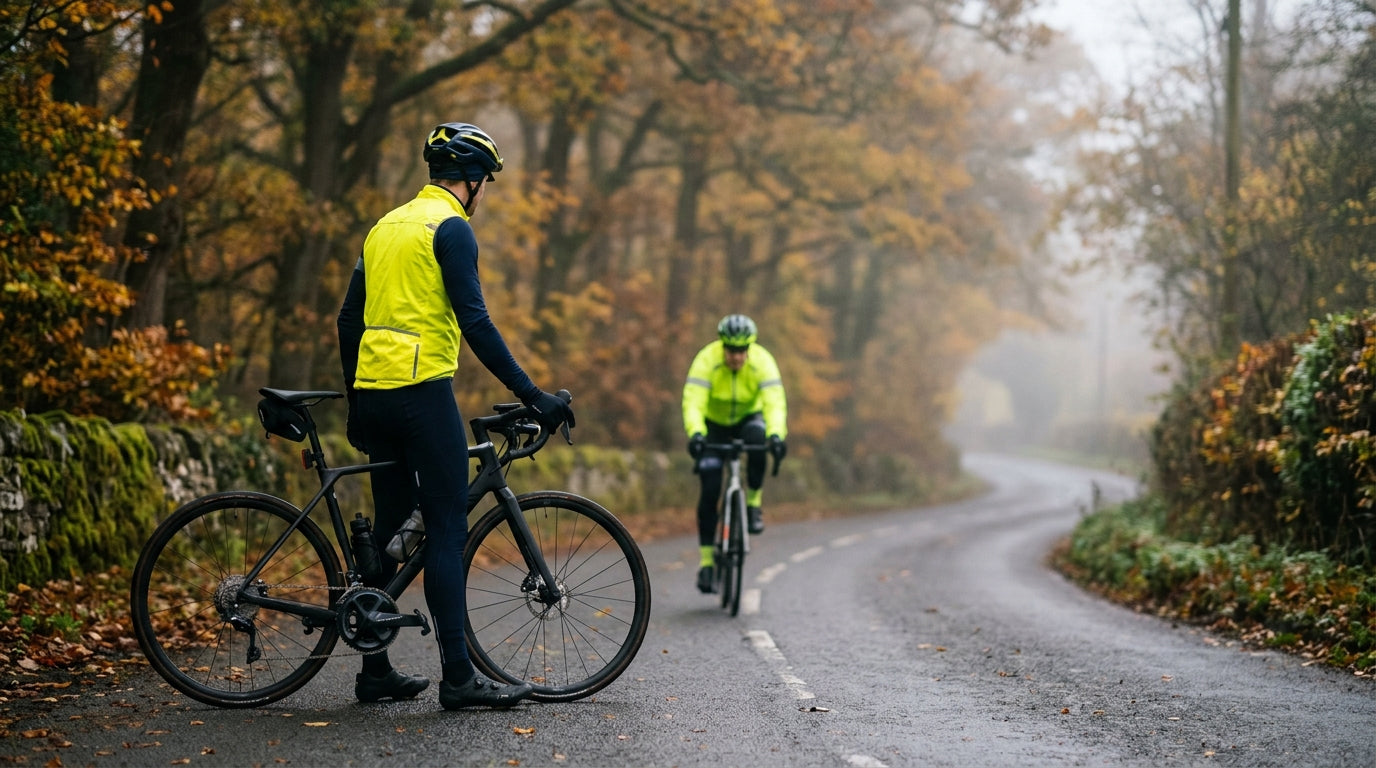
You've decided to buy some reflective gear for your rides or runs. Smart move. But now you're looking at a reflective running gilet and a reflective cycling jacket, and you're not sure which one you actually need. Maybe both? It depends on how you train, what temperatures you're dealing with, and how much British rain you're willing to tolerate.
This guide breaks down when each piece of hi-vis gear earns its place, and when layering them together makes the most sense.
A reflective gilet protects your core while leaving your arms free. That's not just about comfort. It's about temperature regulation. Your core generates the most heat during exercise, and a gilet traps enough of it to keep you warm without turning you into a sweating mess on a tempo run.
Three situations where a gilet is the right call:
That packability is the gilet's real advantage. Experienced cyclists treat a reflective running gilet as an insurance policy: it goes in the pocket on every ride, regardless of the forecast. The UK has a habit of proving forecasts wrong by lunchtime.
There are days when a gilet simply isn't enough. Full arm coverage becomes essential in these conditions:
A good reflective cycling jacket also matters for descents. You work hard climbing a hill, generating plenty of heat. Then you stop pedalling for a five-minute descent and the wind chill hits. Full arm coverage makes a real difference here.
Most experienced runners and cyclists end up with both a gilet and a jacket. Not because they're gear obsessed, but because the UK gives you every possible weather condition across a single week.
A Danish study from Aalborg University found that hi-vis jackets reduce the risk of a motor vehicle collision by 47–55%, with even higher effectiveness in winter (56%) compared to summer (39%). That's a compelling reason to have reflective gear you'll actually wear in every season, not just one piece that only comes out when it's cold enough to justify it.
Here's how the two pieces complement each other:
If you ride or run year-round in the UK, you'll use both regularly. That's not an upsell. It's just how British weather works.
On the coldest days (below 5°C, or any temperature with driving rain and wind), layering both pieces together works brilliantly. Here's how to do it properly:
This three-layer system gives you flexibility. If you warm up mid-ride, unzip the jacket. If conditions improve, strip the jacket entirely and continue in the gilet. You can adapt without stopping.
Use this as a starting point. Everyone runs hot or cold, so adjust based on your own experience.
Remember that cycling feels colder than running at the same temperature. Wind chill from riding at 25km/h can make 10°C feel closer to 5°C. If you do both sports, you'll likely reach for the jacket earlier on the bike than on a run.
If you can only pick one, start with whichever matches your main riding or running season. Training mostly in spring, summer, and early autumn? Get the gilet. It'll cover more of your year and you'll actually wear it rather than leaving a jacket stuffed in a drawer from April to October.
If you commute year-round or run through winter, start with the jacket. It handles the worst conditions, and you can always add a gilet later when the weather warms up.
Either way, you're adding reflective cycling gear that makes you significantly more visible to drivers. A study cited by Road Safety GB found that hi-vis clothing increases your detection distance by up to three times. That matters on dark mornings and dusky evenings, which the UK has plenty of.
For a full breakdown of each product, check our guide to the best reflective running jackets and our guide to the best reflective running gilets. And if you want to go further with visibility, adding a reflective helmet cover completes the picture.
Usually not. The BTR jacket has a relaxed cycling fit and the gilet is thin enough to sit underneath without adding much bulk. If you're between sizes, take the larger size for layering room, but most people in their normal size can fit a base layer and gilet under the jacket comfortably.
Yes. The BTR gilet and jacket both work for cycling and running. Cyclists tend to value the longer drop tail at the back for wheel spray and runners tend to value packability, but the cuts cover both. Some runners find a cycling jacket slightly long at the back, so try it with your usual kit before a long session.
For visibility, yes. A 360 degree reflective gilet lights up under car headlights from any angle, so the panels do the same job a jacket would. Where a jacket adds value is warmth and weather protection on cold or wet nights, not extra reflectivity. On a mild dry night, a gilet plus bike lights covers it.
In dry conditions, yes. A gilet plus thermal arm warmers is a flexible alternative to a jacket and lets you dump heat by pushing the warmers down on climbs. The catch is rain: arm warmers aren't waterproof and a jacket is, so any real chance of a downpour and you'll want sleeves you can trust.
Over the pack if you want the reflective panels visible from behind, because a backpack will hide a gilet worn underneath. If the gilet bunches at the shoulder straps when worn on top, switch to a reflective backpack cover or a reflective ankle band to keep your rear visibility working.


